An independent optometry practice already offered myopia management as a service line. The clinical care was solid. The new patient flow wasn't.
Referrals trickled in from existing patients who already knew and trusted the practice. Google sent occasional traffic to one generic service page describing orthokeratology in clinical language, then nothing. Parents landed, skimmed a paragraph, and left.
Today, that service line generates more than £200,000 in additional annual recurring revenue, driven directly by a content strategy built around how a parent actually searches, worries and decides before committing her child to years of ongoing care.
Here's how it was built.
The buyer isn't the patient
Most eye care content gets written for the person in the chair. Myopia management breaks that assumption immediately. The patient is a child, usually between 6 and 16. The buyer is a parent who is frightened, guilty and skeptical in roughly equal measure.
That distinction changes everything about how the content gets built. A 10-year-old doesn't research treatment options. Their parent does, usually at 11pm on a phone, right after a school screening letter or an offhand comment from a teacher.
Mapping the buyer journey
The first job wasn't writing. It was figuring out what actually happens between "I just found out my child needs glasses" and "we're three years into ortho-k and telling other parents about it."
Four stages emerged.
Stage 1: The flag. A school screening, a pediatrician referral, or a parent noticing their child squinting at the whiteboard. She doesn't know myopia management exists yet. She just knows her child needs glasses.
Stage 2: Is this normal, or is this a problem? She starts researching what myopia actually means for a child, and whether it gets worse over time.
Stage 3: Comparing options and providers. She's learned myopia can progress and can be managed. Now she's weighing ortho-k against atropine drops and specialty lenses like MiSight, and weighing which local practice to trust with it.
Stage 4: Booking the consult. She's picked an approach and a provider in her head. She needs one clear, low-friction next step.
A fifth stage sits outside the funnel entirely: the years of ongoing care after that first booking, where a one-time patient turns into a recurring revenue relationship. More on that below.
Building the empathy map
Before writing a single headline, the team mapped what the Stage 2 and Stage 3 parent says, thinks, feels and does.
Says: "The optometrist said his eyes are getting worse every year." "Is this going to keep happening?"
Thinks: Is this my fault for all the screen time? Can we actually afford this on top of everything else?
Feels: Guilty about screen time. Anxious about what "high myopia" might mean for her child by the time he's 40.
Does: Googles after the kids are in bed. Reads reviews before booking anything.
That map is the gap between a service page listing treatment options and content that speaks to a parent lying awake worried about her son's eyesight decades from now.
Finding where she actually looks
The practice's existing content assumed parents would land directly on a "myopia management" service page. They don't. That exact phrase barely gets searched until a parent already knows the term exists.
But the real touchpoints sit earlier.
The school screening letter. The moment it arrives, a parent searches its exact wording, plus phrases like "does my child need glasses" and "signs of nearsightedness in children."
The existing optometrist visit. Plenty of parents hear the word "myopia" for the first time from a clinician and search it on their phone in the parking lot before they've even left.
Parenting forums and Facebook groups. Long before a Google search, parents ask other parents what worked, what it cost, and whether it was worth it.
Direct search, once she knows the category exists. This is where most practices start and stop, missing the three touchpoints above entirely.
The pain points nobody was writing about
The practice's original content answered a question almost nobody was asking: what is orthokeratology. The real pain points sat underneath that question, and they were mostly emotional, not clinical.
Fear of the long-term outcome. Parents weren't worried about glasses. A quick search told them what high myopia can mean later in life: retinal detachment risk, myopic maculopathy, glaucoma. Nobody at the practice was addressing that fear directly, so parents were absorbing it from worst-case forum posts instead.
Guilt. Screen time gets blamed constantly, in casual conversation and in the press. A lot of parents arrive already blaming themselves.
Cost and insurance confusion. Vision insurance rarely covers myopia management, and most parents didn't find that out until deep into a conversation with the front desk. That gap was creating the drop-off, not the price itself.
Is this evidence-based, or an upsell? Ortho-k and specialty lenses aren't cheap, and parents who'd never heard the term "myopia management" before this year were naturally wary it was a premium add-on invented to pad the bill.
Search intent and the long tail that actually converts
Generic keyword research for "myopia management" targets a term most parents don't use until Stage 3. The brief mapped keywords to each stage of the journey instead of chasing the single highest-volume term.
Stage 1: "child squinting at the board," "why does my child's eyesight keep getting worse."
Stage 2: "can myopia be cured," "risks of high myopia in adulthood."
Stage 3: "ortho-k vs MiSight vs atropine drops," "does insurance cover myopia management."
Stage 4: "myopia management near me," "myopia management cost."
Each Stage 2 and Stage 3 term carries far lower search volume on its own than "myopia management." Together, they carry a parent through the exact questions she's actually asking, in the order she's asking them, and they convert at a level a single high-volume page never could.
Content built for each stage of the journey
Four pieces of content replaced the one static service page.
A plain-language guide for Stage 2, answering "is this normal, or is this a problem," written to rank for the fear-driven questions parents ask right after a screening.
A head-to-head comparison of ortho-k, atropine drops and MiSight for the Stage 3 parent actively weighing options, written with a clear point of view instead of a neutral list.
A cost and insurance page that states plainly what's covered, what isn't, and why the investment makes sense over years. It answers the question and removes the reason parents were dropping off mid-conversation.
A local, consult-focused page for Stage 4, with one job: a booked appointment, not more reading.
From click to booked consult
Every piece of content ended the same way: one specific next step, a direct link to book a myopia assessment, never a vague "learn more."
The comparison and cost pages did the trust-building work before a parent ever spoke to the front desk. So the phone call or the booking became a formality instead of a sales conversation.
From new patient to years of recurring revenue
Myopia management isn't a one-time appointment. A committed patient stays in active treatment for years, with regular progress checks, which is exactly why the ARR number matters more than a traffic number.
The content didn't stop at the booking. Follow-up content for enrolled families addressed the next round of worry: is the treatment working, what does a progress check actually measure, and what happens if we want to stop. Parents who felt informed at every stage were the ones who stayed in treatment, and the ones telling other parents where to go.
The result
Over [PLACEHOLDER — engagement timeframe], this content strategy became the practice's primary driver of new myopia management patients, adding more than £200,000 in new annual recurring revenue directly attributable to the content.
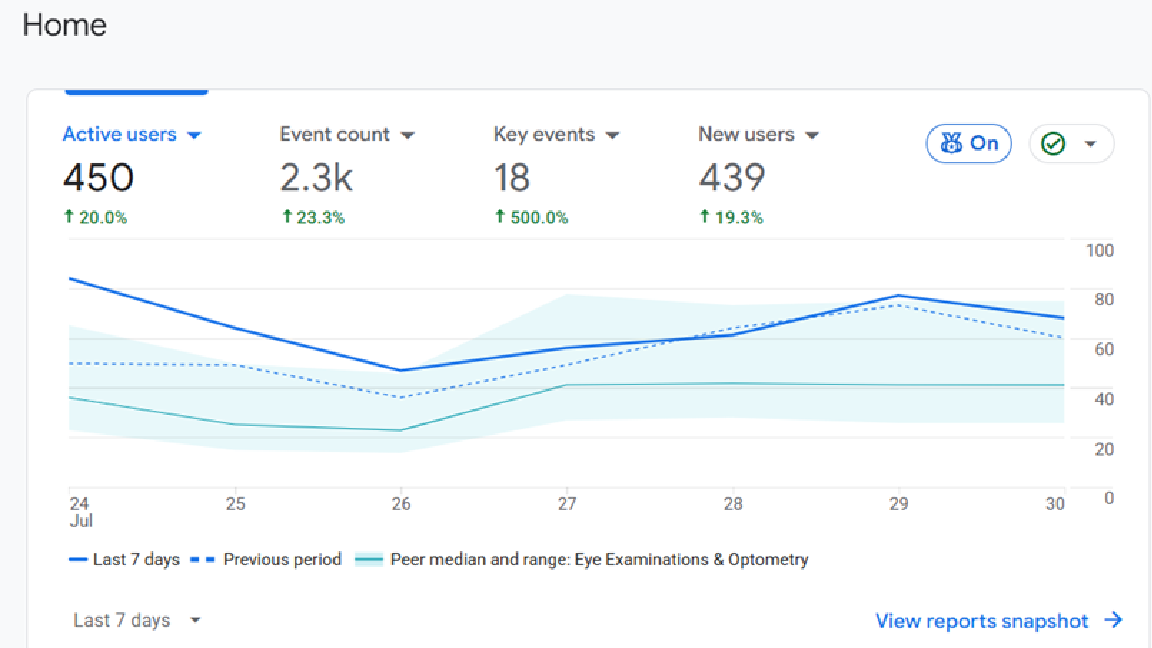
A recent seven-day snapshot from the practice's Google Analytics shows the current run rate: active users up 20% and key events, mostly booking enquiries, up 500% on the previous week. [PLACEHOLDER — full-campaign organic traffic lift] and [PLACEHOLDER — keyword rankings achieved] still need adding before this goes live.
The service line already existed before this strategy. This content met a frightened, guilty, skeptical parent where she actually was, at every stage between "I just found out" and "we've been doing this for three years."
In the practice owner's words
"Before this, our myopia management page barely got found, and when it did, people left without booking. Our clinical side has always been solid. The gap was content that actually spoke to how parents think and search."
"Now we're adding roughly two new myopia patients a week, most of them booking straight from the guide and comparison pages before they ever call the front desk. A new patient starts at around £300, then stays on for about £60 a month, and a lot of these families stay with us for a decade or more."
"This one service line is now bringing in more than £200,000 in new annual recurring revenue, and I've already recommended PulseCopy to two other practice owners."
— Practice owner, independent optometry practice (name withheld at the client's request)
The numbers behind it
What this proves
A buyer journey, an empathy map and a stack of long-tail keywords did the work here. They turned a service page nobody found into a £200,000-a-year growth driver, one honest answer to a real parent's fear at a time.